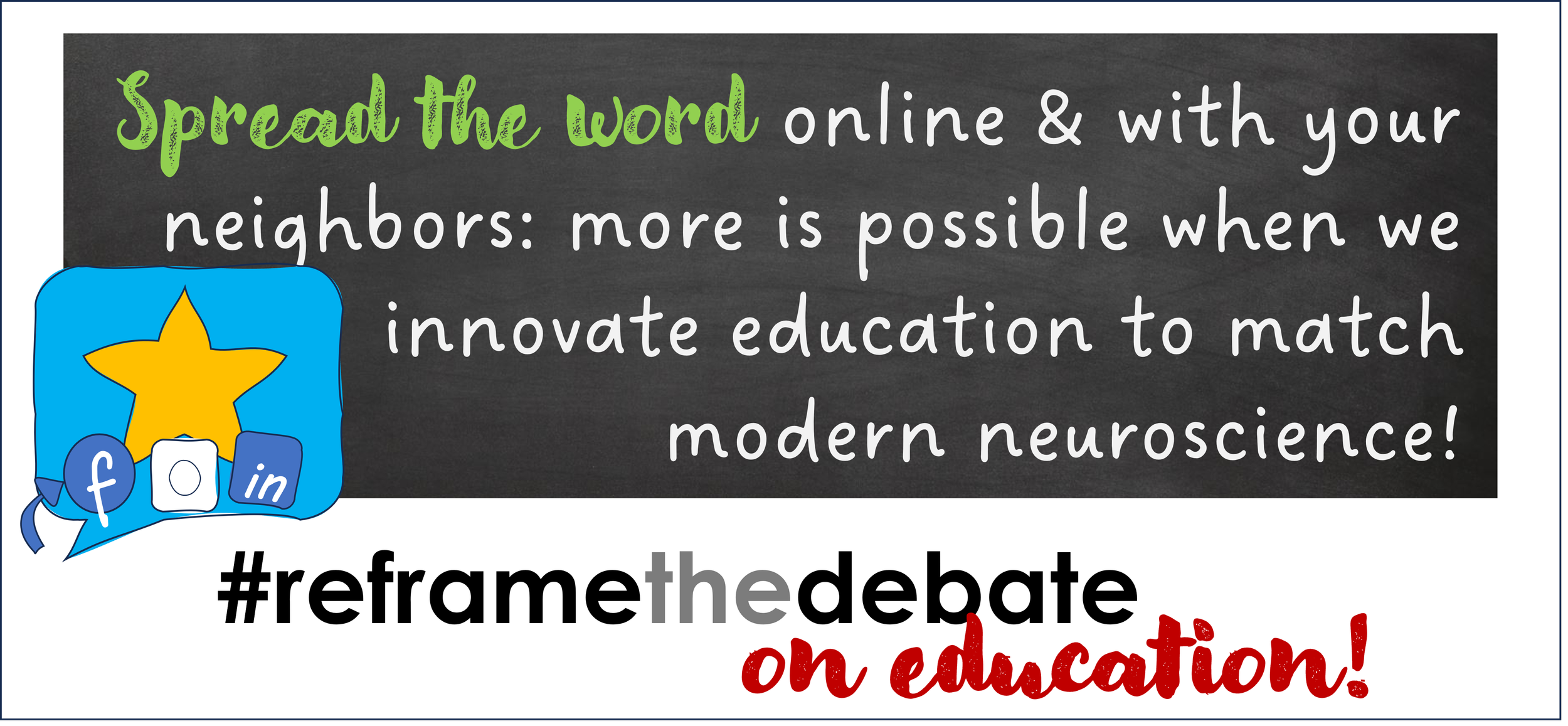
Help us spread the word about what’s possible when we apply neuroscience in education!
It’s time to stop debating “how can we reduce special ed costs” and start debating “how can we foster innovation reducing the special ed needs that are so costly to support!”
Join our movement to reframe the debate on education by helping us spread the word, and then scroll down to find other easy ways you can help!
Help us Change the Conversation in Your Community
Why This Matters:
Most people don't know innovation in special education exists—or that current educational policy in Connecticut unintentionally holds it back.
Your conversations change that. Every time you mention what's possible when we step away from “how it’s always been done” and apply neuroscience in education in new ways, you shift what one more person thinks is possible for a child, a school and K-12 education as a whole. And every time you mention how our educational funding structures unintentionally make it hard for independent schools to deploy these exciting techniques, and hard for families to access them, your conversation at the bus stop or social media share can reach someone who might be a school board member, a parent who needs this, a donor who could help, or a legislator who needs constituent pressure.
The movement grows conversation by conversation.
We're not asking you to become an activist or expert. We're asking you to share what you know when opportunities arise naturally.
1. SHARE ON SOCIAL MEDIA
Pick a post, customize it, share it.
We've written posts you can use as-is or personalize. Choose what resonates with you:
-
December 11: Join Cajal Academy in celebrating their SONO landmark building’s 101st birthday, and launch their #ReframeTheDebate campaign to raising awareness of how neuroscience can be used to super-size what’s possible for a child and for education as a whole in the future!
See innovation in action. Support research expansion. Help policymakers find out what’s possible!
Tickets $25 adults / $10 kids: www.cajalacademy.org/events/101-bday-bash
Can't attend? Donate: www.cajalacademy.org/give
-
Connecticut has a nonprofit proving you can transform special education outcomes while reducing costs by using modern neuroscience to change the underlying profile itself—students gaining 2-6 grade levels in a single year, socially-isolated kids becoming recognized as social leaders, kids who were on a freight train towards therapeutic placements instead finding the ‘decoder ring’ they need to understand, and change, their own experiences…the results are transformative. And because this approach identifies and address root neuropscyhological causes rather than just accommodate them, it can lead to savings of $50K-$150K per child per year for the rest of K-12.
The challenge: Current policies were written before anyone knew this was scientifically possible. Now we need policymakers to know innovation exists so policy can catch up.
Learn more: www.cajalacademy.org/join-the-movement
#ReframeTheDebate #CTInnovation #neuroscienceineducation #jointhemovement
-
CT taxpayers: We're spending $1.5M-$2.5M per student on therapeutic placements that don't solve underlying problems.
A South Norwalk nonprofit proves you can connect the dots between neuropsychological differences and the cascade of learning, social-emotional and behavioral differences they cause and then address root causes in as little as 1-2 years. And because this approach identifies and address root neuropscyhological causes rather than just accommodate them, an upfront investment of $70K-$150K can lead to savings of $50K-$150K per child per year for the rest of K-12. For an elementary child, that means a 10-fold financial return on investment, and a complete transformation in academic and social-emotional terms as well—so much so that they actual DECREASE tuition as the child progresses through their process.
That’s a solution that could be saving our towns millions, but families trying to access it are being blocked by school districts under policies that were created before people knew this neuroscience-based approach was even possible, and under legislation passed last spring to reduce the costs of special ed. Come again?
Policymakers need to know this innovation exists, because our kids and our towns simply can’t afford the status quo.
www.cajalacademy.org/join-the-movement
#CTBudget #FiscalResponsibility #Innovation
-
When Connecticut's special ed policies were written, scientists thought disabilities couldn't be changed—only accommodated.
Now we know different. One CT nonprofit has proven you can reduce or remove disabilities using neuroplasticity.
But policies haven't caught up yet. Districts don't realize current law already permits this.
Time to raise awareness: www.cajalacademy.org/join-the-movement/contact-policymakers
#ReframeTheDebate #CTPolicy
-
Did you know? Special education as a field evolved when scientists thought your abilities were largely fixed by the end of early childhood, so learning disabilities were immutable.
Turns out they were wrong: your brain is actually rewiring itself all the way until the day you die to better do those things you frequently ask it to do.
One Connecticut non-profit school run by a Mom on a Mission is proving that we can drive that process to reduce or even REMOVE learning disabilities and in some cases social-emotional and executive function ones as well—bringing down the costs of meeting that child’s needs while super-sizing the possibilities for their futures.
That’s a breakthrough that could revolutionize the whole field; now they need our help to make it accessible to families who are coming up against regulations that are designed for the old ways of doing things.
Innovation this big doesn’t usually start with one mom on a mission—but this one did. Join their movement to help #reframethedebate on education, and consider making a donation to support their work.
-
Good policies can have unintended consequences.
Last May, Hartford passed major legislation to reduce special ed costs, but in the process they put up even more barriers blocking innovative educational approaches that apply neuroscience to REDUCE costs!
Result: Innovation proving both better outcomes and lower costs can't scale, and only the wealthiest of our kids can get access.
This isn't malicious—it's a mismatch between policy intent and implementation. Tell policymakers you want them to support homegrown innovation that can put Connecticut on the map—and on the road to lowering costs while super-sizing student outcomes!
www.cajalacademy.org/join-the-movement/email-your-boe
#CTEducation #reframethedebate #jointhemovement
-
Neuroscience has proven something special education policies weren't designed for: you can address root causes of learning disabilities, not just accommodate them.
A South Norwalk nonprofit has documented this with 40 students over 6 years.
Now we need policymakers to know this science exists so policy can enable it.
www.cajalacademy.org/join-the-movement
#Neuroscience #CTInnovation
-
Connecticut policymakers need to know: Innovation in special education exists that wasn't scientifically possible when current policies were written.
Help raise awareness: www.cajalacademy.org/join-the-movement/contact-policymakers
#ReframeTheDebate #CTEducation #jointhemovement
-
When special ed policies were created, they reflected the science of that time: disabilities are permanent, accommodate indefinitely.
Science has advanced. We now know brains rewire through neuroplasticity.
One CT nonprofit has proven you can apply this—dramatically better outcomes, significantly lower costs.
Now it’s time for policy to catch up with the science so CT families can access it.
www.cajalacademy.org/join-the-movement
#ScienceAdvances #PolicyCanToo
2. HAVE CONVERSATIONS IN YOUR COMMUNITY
Use these conversation starters when opportunities arise naturally; you don't need to be an expert. Just share what you know when it's relevant.
-
WHEN: Someone mentions school budgets or special education costs
YOU SAY:
"Did you know there's a program in South Norwalk proving you can actually reduce learning and in some cases social-emotional and executive function disabilities while actually reducing costs? Students are gaining multiple grade levels per year and therapeutic placements are being prevented—saving towns $1-2M per student. So far they’re only working with kids who have certain profiles but they hope to expand that and public their findings so CT public schools could do it too—but families can’t afford programs like this on their own. Families with kids in real crisis are just being shot down, leading to costly law suits against our town that lead ot therapeutic outplacements that cost even more—while alienating our neighbors as well. We need policymakers to know this innovation exists, and that simply denying things that can do more for kids isn’t necessarily even the most effective way to reduce the bottomline!"
-
WHEN: Public comment period on budget/special ed costs
YOU SAY:
"I want to share information about a cost-reduction opportunity our board may not be aware of. There's a nonprofit school in South Norwalk that has developed a research-backed way to reduce or remove learning disabilities and in some cases even prevent therapeutic placements—which typically cost $150K-$250K per year— by identifying and addressing neuropsychological root causes. Kids with complex profiles have gone up as much as 2-6 grade levels in a year. This can reduce long-term district costs even more than going to state-approved schools, because they rewire the child’s profile itself—that’s innovation that would put our town on the map and provide a ray of hope for our long term budget crises, but the district needs the Board’s leadership to pursue it. Has our board reviewed how special ed innovation could be reducing our costs? I'm happy to share more information or facilitate an introduction."
-
WHEN: Discussion of special education or school budgets
YOU SAY:
"I recently learned about something interesting—there's an approach in the heart of SONO in Norwalk, Connecticut that's transforming special education outcomes while reducing costs. It applies neuroscience that wasn't available when current policies were created. They're proving you can address root causes of learning disabilities instead of just accommodating them year after year. So far they’re only doing this with kids who have certain profiles but they hope to publish their work and then start testing its application for other profiles of kids. The challenge is getting policymakers and districts to understand this is now scientifically possible so policy can catch up. Thought parents here might want to know this option exists."
-
WHEN: They share frustrations about their child's struggles
YOU SAY:
"Have you heard about Cajal Academy in South Norwalk? They take a completely different approach—using neuroscience to address why the learning challenges exist instead of just accommodating them. It was started by a Mom who refused to accept what the schools were telling her when she learned about science suggesting that we can do more. They say kids can go from multiple years behind to multiple years ahead in just a year or two. So far they’re only doing this with kids who have certain profiles but they hope to publish their work and then start testing its application for other profiles of kids. The challenge is getting policymakers and districts to understand this is now scientifically possible so policy can catch up and make it easier for them to expand so all our kids can benefit. Amazing what happens when a Mom is trying to take care of her kids! Might be worth looking into.”
-
WHEN: Relatives ask "what's new?" or discuss education/policy/taxes
YOU SAY:
"I got involved in something interesting—helping raise awareness about special education innovation that's scientifically possible now but wasn't when current policies were written. We have a nonprofit here in Connecticut proving you can reduce learning disabilities using neuroplasticity—dramatically better outcomes, significantly lower costs. The gap is just that policymakers don't know this science exists yet, so policies haven't caught up. It's a good example of how quickly science can advance beyond what policy anticipates, and how private sector solutions can help reduce public sector costs, too."
-
WHEN: Discussion of rising special education costs
YOU SAY:
"I wanted to share information about an approach that could help with these escalating costs. When our special education policies were created, scientists thought disabilities were permanent—you could only accommodate them indefinitely. But neuroscience has proven brains rewire through neuroplasticity. One Connecticut nonprofit has documented they can reduce or remove disabilities in 1-2 years rather than accommodate for 12+ years. Worth exploring whether our district is taking advantage of local innovation that could be transformative for our kids—and proving that better services can actually be less costly!"
-
WHEN: Discussing education challenges or innovation
YOU SAY:
"Have you heard about the neuroscience-based approaches to special education? There's a nonprofit in Connecticut proving you can address neuropsychological root causes rather than just accommodate symptoms—really dramatic results. The interesting challenge is that policies were designed around accommodating permanent disabilities, so there's a mismatch now that science shows we can actually reduce the disabilities themselves. It's creating this gap between what's scientifically possible and what policy was designed to enable. You might be interested in checking out their work."
Thanks for spreading the word!
Here are some more ways you can help spread our movement: